
How to Identify High Quality Borosilicate Glass
Table of Contents
- What Makes Borosilicate Glass High Quality
- Borosilicate Glass vs Soda-Lime Glass: Key Differences
- How to Tell if Glass is Borosilicate: Visual Inspection Methods
- Understanding Borosilicate Glass Markings and Standards
- Borosilicate Glass Quality Checklist: What to Inspect Before Buying
- Limits of DIY Identification Tests and When to Trust Seller Credentials
- Conclusion
- Frequently Asked Questions
Last Updated: October 12, 2026
What Makes Borosilicate Glass High Quality
High-quality borosilicate glass stands apart because of its composition: silica and boron trioxide, which give it superior heat resistance and durability compared to standard soda-lime glass.

The difference comes down to three things: materials, manufacturing process, and how well the finished piece is made.
Quality borosilicate glass shows telltale signs: crystal-clear without cloudiness, smooth to the touch, and properly annealed (cooled slowly to remove stress and prevent breakage).
Check wall thickness: thicker walls mean better durability and heat resistance, while thin glass breaks easily under temperature changes.
Borosilicate Glass vs Soda-Lime Glass: Key Differences
Understanding how borosilicate differs from soda-lime is essential when you're trying to identify high quality borosilicate glass.

Borosilicate glass contains about 80% silica and 13% boron trioxide, giving it exceptional thermal and chemical resistance. It handles rapid temperature changes without cracking or shattering.
Soda-lime glass is made from silica, sodium carbonate, and calcium oxide.
Here's what matters in practice:
- Heat resistance: Borosilicate tolerates temperatures from -40°C to 230°C. Soda-lime fails at much lower temperature ranges.
- Thermal shock: Borosilicate survives rapid temperature swings. Soda-lime cracks if you pour hot liquid into a cold glass.
- Chemical resistance: Borosilicate resists acids, bases, and most chemicals. Soda-lime can leach chemicals into food and beverages.
- Durability: Borosilicate lasts years with proper care. Soda-lime chips and breaks frequently.
- Clarity: High-quality borosilicate is crystal-clear. Soda-lime often has a slight greenish or brownish tint.
When comparing products, ask the seller about glass composition. If they can't confirm it's borosilicate, it's probably soda-lime.
How to Tell if Glass is Borosilicate: Visual Inspection Methods
Checking for Clarity and Transparency
The first thing to examine is clarity. Hold the glass up to natural light: high-quality borosilicate should be completely transparent with no cloudiness.
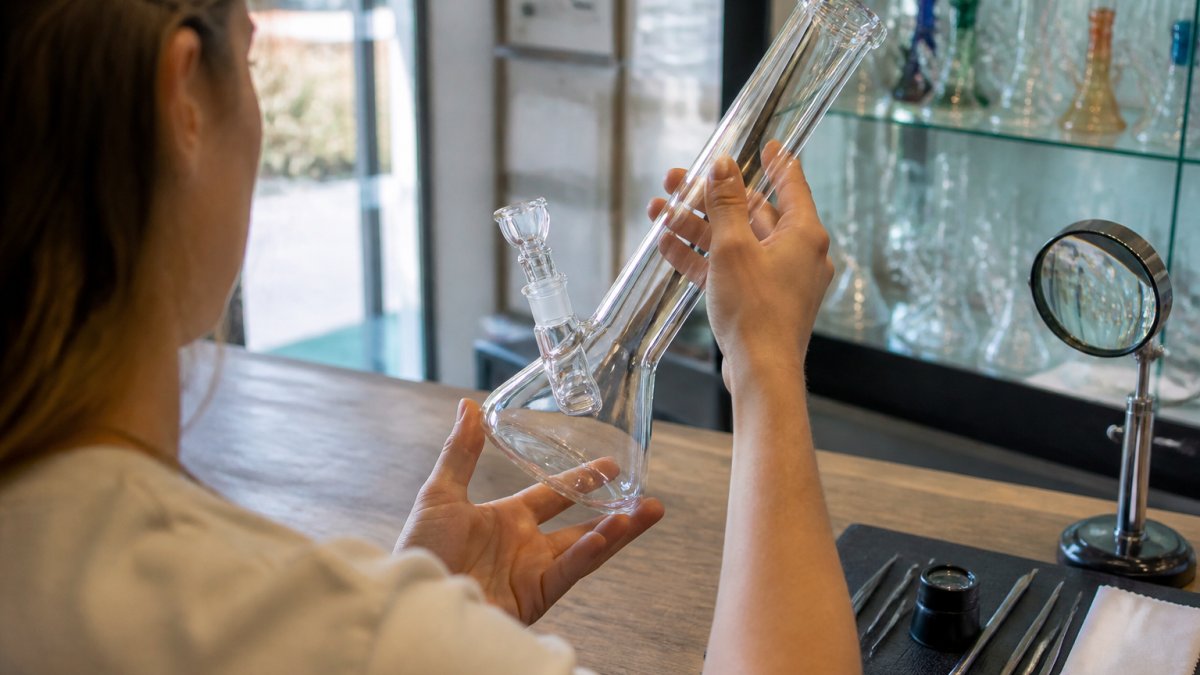
Cloudiness or haze means the glass wasn't properly annealed and suggests it might be soda-lime, not borosilicate.
Look for tint too. Premium borosilicate is colorless; a slight green, brown, or blue tint signals soda-lime. Borosilicate can be colored intentionally, but the color should be uniform.
Detecting Surface Defects and Quality Issues
Run your fingers along the inside and outside surfaces.
Look closely for bubbles. Trapped air pockets weaken glass and create stress points where cracks start.
Streaks and waves are another red flag, occurring when glass wasn't mixed properly or cooled unevenly.
Check seams and joints on multi-part pieces.
Inclusions are tiny trapped particles. Some are unavoidable, but excessive inclusions suggest poor manufacturing.
Understanding Borosilicate Glass Markings and Standards
Quality manufacturers mark their borosilicate glass with composition and standards information. Learning to read these markings helps you identify high quality borosilicate glass with confidence.

What a legitimate marking should tell you
A trustworthy marking or product listing typically includes four things:
- Material name: The words "borosilicate glass" or "borosilicate 3.3" spelled out, not just "boro" or "heat-resistant glass."
- A referenced standard or specification: A standard number, a material designation, or a documented test the manufacturer claims to meet.
- A temperature rating: A stated safe operating range, usually expressed in degrees Celsius for products sold here.
- Manufacturer identity: A company name, address, or traceable brand that can be contacted if something goes wrong.
If a product has none of these, you are being asked to take a quality claim on faith.
Standards and grades worth knowing
Borosilicate is a family of glasses, and the grade matters for performance:
- Borosilicate 3.3 is the most common designation for laboratory and premium consumer glassware. The "3.3" refers to a low coefficient of thermal expansion, which is what gives it strong resistance to thermal shock. This is the grade most buyers should look for when heat resistance is the priority.
- Borosilicate 5.1 and similar higher-expansion grades exist and are still borosilicate, but they tolerate less severe temperature swings than 3.3. A product can honestly say "borosilicate" and still underperform if you assume all borosilicate behaves the same.
- Soda-lime glass is a separate material entirely. It is not a grade of borosilicate, and no marking should blur the two.
For food contact, laboratory use, or repeated heating, manufacturers often reference recognized testing frameworks. Rather than memorizing standard numbers, ask the manufacturer or retailer which standard or material designation the product is made to, and whether they can provide documentation.
How to verify rather than assume
Appearance cannot confirm composition, two identical-looking pieces can be different materials. Verification comes from documentation:
- Ask for the material specification sheet. Reputable manufacturers publish or provide a technical data sheet listing composition, expansion coefficient, and recommended temperature limits.
- Ask for the standard or grade. "Which borosilicate grade is this made to?" is a fair question. A knowledgeable seller answers it.
- Check the packaging and listing text. Look for the material name, grade, temperature range, and manufacturer in writing, not just in marketing copy.
- Cross-check the brand. If the brand has a website, the same specifications should appear there. Inconsistencies between the listing and the manufacturer's own documentation are a red flag.
- Request a declaration of conformity or test report for products where safety matters, such as food-contact or heat-exposed items.
Look up a glass material designation or standard reference
Red flags in markings and claims
- Vague phrases like "thermal glass," "heat-resistant glass," or "boro-silicate" with no grade or standard.
- A temperature rating with no unit or no source.
- No manufacturer name anywhere on the product or packaging.
- A listing that claims borosilicate but describes soda-lime characteristics, such as a green edge tint or a low stated heat tolerance.
- Standards referenced by number but never explained, with no documentation available on request.
Borosilicate Glass Quality Checklist: What to Inspect Before Buying
Before buying any borosilicate glass product, use this checklist to evaluate quality and avoid poor-quality pieces.
| Inspection Point | What to Check | What to Look For |
|---|---|---|
| Clarity | Hold to light and look through | Crystal-clear, no cloudiness or haze |
| Color | Examine the tint | Colorless (unless intentionally colored) |
| Surface texture | Run fingers inside and out | Perfectly smooth, no roughness |
| Bubbles | Look at light angles | Few or none; avoid visible air pockets |
| Streaks and waves | Examine for patterns | Uniform appearance, no visible streaks |
| Joints and seams | Check connection points | Smooth, seamless, well-finished |
| Inclusions | Look through at angles | Minimal particles, not excessive |
| Markings | Read labels | States "borosilicate" clearly |
| Manufacturer info | Check for company name | Known brand with traceable information |
| Temperature rating | Look for specifications | Shows tested safe temperature range |
Work through each point: a piece that passes all checks is likely high quality, while one that fails multiple checks should be skipped. Quality borosilicate glass should pass at least 8 of these 10 points. Pay special attention to clarity, surface texture, and visible defects, the easiest to spot and most reliable indicators of quality.
Limits of DIY Identification Tests and When to Trust Seller Credentials
Visual inspection gets you most of the way there, but it has limits: you cannot definitively prove borosilicate composition just by looking, and the home tests circulating online are more likely to damage your product or mislead you than to give a reliable answer.
Why the popular DIY tests do not work
The thermal shock test. Heating glass and plunging it into cold water, expecting soda-lime to crack and borosilicate to survive, is not diagnostic.
The weight test. Borosilicate is sometimes described as heavier, but weight is driven by wall thickness, shape, and volume, not material.
The sound test. Tapping glass and listening for a ring is a parlor trick.
The scratch or hardness test. Glass hardness varies within both material families and is affected by surface treatment.
What actually distinguishes a reliable seller
Since you cannot verify composition at home, verification shifts to the seller and the documentation trail. A reliable seller demonstrates four things:
- They can name the material and grade. "Borosilicate 3.3" or a specific material designation is a real answer. "It's good glass" is not.
- They can point to documentation. A technical data sheet, a specification listing, or a manufacturer's product page with composition and temperature limits.
- They carry traceable brands. Established manufacturers publish specifications and stand behind them. Unknown brands with no verifiable history are harder to hold accountable.
- They answer questions consistently. Ask the same question twice, or compare the listing to the manufacturer's own site. Consistent answers suggest genuine knowledge; contradictions suggest guesswork.
Questions to ask before you buy
- What grade of borosilicate is this, and what is its coefficient of thermal expansion?
- What is the safe temperature range, and is that rating for the material or the finished item?
- Can you provide a specification sheet or declaration of conformity?
- Who is the manufacturer, and where can I find their documentation?
- Is this item rated for the specific use I have in mind, stovetop, oven, freezer, or sudden temperature change?
That last question matters more than most buyers realize. A material's thermal properties don't guarantee every finished item is safe for every use, thickness, shape, joins, and annealing all affect performance. A borosilicate lid and a borosilicate casserole dish can carry very different use limits despite sharing the same material.
Conclusion
Identifying high quality borosilicate glass comes down to understanding composition, recognizing quality markers, and knowing what to inspect visually. Clarity, smooth surfaces, minimal defects, proper markings, and trusted seller credentials are your best guides.
When you're ready to buy borosilicate glass products, shop with a retailer you trust. Bay Roberts Vape and Glass Shop carries authentic, high-quality borosilicate glass from brands like Hoss Glass, and our team can answer your questions about composition, durability, and proper use.
Frequently Asked Questions
Is borosilicate glass non-toxic and safe for cannabis use?
Yes, borosilicate glass is non-toxic and food-safe, making it ideal for cannabis accessories. Its composition of silica and boron trioxide creates a chemically inert surface that doesn't leach harmful substances when exposed to heat or smoke. This is why borosilicate is the standard material for laboratory glassware and premium cannabis accessories like the Bongjour! hand pipes and Amber Honey Comb bongs we carry, they're designed specifically for safe, clean consumption.
How can you tell if glass is borosilicate versus soda-lime?
The most reliable indicator is checking for markings on the product or packaging that specify borosilicate composition. Visually, borosilicate glass typically has superior clarity with fewer bubbles and streaks. Soda-lime glass is more prone to cloudiness and surface defects. However, visual inspection alone isn't foolproof, always verify through product specifications, seller credentials, or material labeling rather than relying solely on appearance.
What markings should I look for on high-quality borosilicate glass?
Quality borosilicate pieces often display manufacturer logos, product specifications, or material labeling indicating borosilicate composition. Look for terms like 'borosilicate glass' or references to thermal resistance. Reputable retailers like Bay Roberts Vape and Glass Shop, the exclusive licensed retailer for Hoss Glass, provide documentation of authenticity and material specifications with every premium piece.
What should I check for when buying borosilicate glassware or cannabis accessories?
Inspect for crystal-clear transparency, smooth surfaces free of bubbles or streaks, proper wall thickness (thicker glass indicates better durability), and any visible manufacturer markings. Check that the piece has been properly annealed for strength. Verify the seller's credentials and ask for material specifications. Our quality checklist covers all these points and helps you identify pieces designed for long-lasting use and safe consumption.