
How to Start Vaping Safely in 2026
Table of Contents
- Understanding Vaping Basics Before You Begin
- Beginner Vape Device Guide: Choosing Your First Kit
- How to Choose Vape Nicotine Strength for Your Needs
- Mastering the Correct Inhale Technique
- Vape Safety Tips for Beginners: What You Need to Know
- Vaping and Quitting Smoking: A Practical Transition
- Getting Started Safely: Your First Steps
- Frequently Asked Questions
Last Updated: October 6, 2026
Understanding Vaping Basics Before You Begin
To start vaping safely, you need to understand what you're doing before you pick up a device. Vaping heats e-liquid into aerosol, while smoking burns tobacco into smoke, a distinction that changes how your body responds and what precautions you need.
E-liquid contains four main components: propylene glycol (PG), vegetable glycerin (VG), nicotine, and flavorings. Higher PG ratios deliver more throat sensation and stronger nicotine delivery; higher VG ratios produce denser clouds and smoother inhales.
Nicotine concentration is measured in milligrams per milliliter (mg/mL), but absorption depends on your inhale technique, device power, and nicotine type. Freebase nicotine works best in lower concentrations with higher-power devices; nicotine salts allow higher concentrations to feel smooth, ideal for mouth-to-lung vaping and smoking cessation.
At Bay Roberts Vape and Glass Shop, we help newcomers navigate these fundamentals before they waste money on the wrong device. The right starter kit matches your inhale preference and nicotine requirements, not just your budget.
Beginner Vape Device Guide: Choosing Your First Kit
Your first device should be simple, reliable, and matched to how you plan to inhale. Pod systems and pen devices dominate the beginner market because they eliminate coil building, wattage adjustment, and advanced settings, the goal is something you'll actually use consistently.
Pod Systems vs. Pen Devices
Pod systems use pre-filled or refillable cartridges with integrated coils: fill the pod, insert it into the battery, and vape. Most deliver mouth-to-lung (MTL) hits that mimic smoking, making them the best starting point for smokers because the throat hit and hand-to-mouth ritual feel familiar.
Pen devices use larger tanks with replaceable coils and offer adjustable airflow, variable wattage, and bigger e-liquid capacity, but they're more complex to maintain. They suit vapers who've committed to the habit and want to experiment with coil resistances and power outputs; for absolute beginners, the complexity often frustrates.
The Uwell Caliburn Alpha Air Kit is an excellent beginner pod system: it weighs just 39 grams, draws are button-free, and the 1000mAh battery lasts a full day for most users. Its G Pod Platform delivers consistent flavor and longer pod life. At $25.00, it's an affordable entry point.

Key Specifications to Look For
When comparing beginner devices, focus on battery capacity (mAh), coil resistance (ohms), and maximum wattage. A 1000mAh battery lasts roughly one day of moderate vaping; heavy vapers should look for 1300mAh or higher. Coil resistance determines inhale style: lower ratings (0.4-0.6 ohm) are DTL, higher ratings (0.8-1.2 ohm) are MTL.
The SMOK Arco Max Kit appeals to intermediate beginners with a 1300mAh battery, adjustable wattage from 5W to 30W, stepless airflow control, and a display. It includes both 0.6 ohm and 0.8 ohm pods for MTL and restricted direct-lung (RDL) vaping. At $36.00, it bridges ultra-simple pod systems and complex mods.
Battery safety is non-negotiable. All the devices we recommend use built-in, non-removable batteries, eliminating external battery handling errors. USB-C charging is standard, and fast charging (1.5A or higher) tops up in under two hours. Always use the included charger or a reputable USB-C charger rated for your device.
How to Choose Vape Nicotine Strength for Your Needs
Nicotine strength is where most beginners get the math wrong. Nicotine delivery depends on your device, inhale technique, and e-liquid type; a high-nicotine salt in a low-power pod delivers more per puff than low-concentration freebase in a high-power device.
Match nicotine strength to your smoking history: light smokers (under 10 cigarettes daily) start at 3-6 mg/mL freebase or 10-20 mg/mL salts; moderate smokers (10-20 daily) at 6-12 mg/mL freebase or 20-30 mg/mL salts; heavy smokers (20+ daily) at 12-18 mg/mL freebase or 35-50 mg/mL salts.
Nicotine salts are gentler on the throat than freebase at equivalent strengths. If you experience throat irritation or nausea, the issue is usually too much nicotine; lower the concentration by 5-10 mg/mL and reassess. If you're still craving cigarettes after a week, increase slightly.
PG/VG ratio also affects nicotine perception: higher VG liquids dilute nicotine slightly, so you absorb less per puff. If a high-VG liquid leaves you under-satisfied, switch to a higher-PG liquid at the same strength.
Mastering the Correct Inhale Technique
How you inhale determines whether vaping satisfies your smoking habit or feels completely wrong. The two primary techniques are mouth-to-lung (MTL) and direct-to-lung (DTL), and using the wrong one with the wrong device creates a terrible experience.
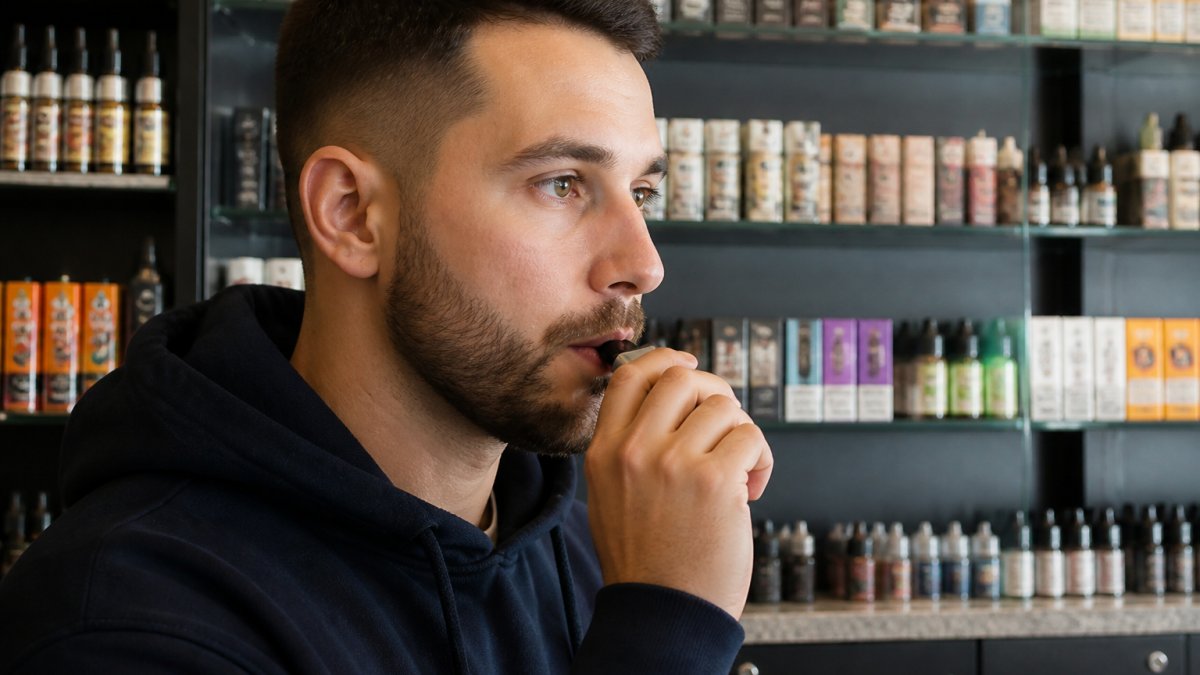
Mouth-to-Lung vs. Direct-to-Lung Inhaling
Mouth-to-lung (MTL) vaping mimics smoking a cigarette: draw vapor into your mouth, hold briefly, then inhale into your lungs. It uses higher coil resistance (0.8-1.2 ohm) and tighter airflow, producing less vapor but stronger throat hit and nicotine sensation.
Direct-to-lung (DTL) vaping is the opposite: inhale vapor straight into your lungs in one motion, like a deep breath.
The Vaporesso Eco Nano Kit is purpose-built for MTL vaping. Its 0.8 ohm coil, tight airflow, and 1000mAh battery create the exact sensation smokers expect.

With an MTL device, draw slowly through your mouth for 3-4 seconds, hold the vapor 1-2 seconds, then inhale into your lungs; the two-step process is key.
New vapers often cough during their first week, which is normal and usually temporary, caused by vapor irritating the throat differently than smoke or by inhaling too aggressively. Slow your draw, lower your nicotine strength, or try a higher-PG liquid.
Vape Safety Tips for Beginners: What You Need to Know
Vaping is not risk-free, but it's significantly less harmful than smoking when done correctly. The main beginner concerns are nicotine overdose, device malfunction, and poor maintenance; understanding and preventing them is the difference between a safe transition and a frustrating one.
Battery Safety and Device Maintenance
All modern beginner devices use built-in, non-removable lithium batteries, which are safer than external batteries because you can't insert them incorrectly. Still, use a USB-C charger rated for at least 1A output and avoid cheap, off-brand chargers that lack voltage regulation and can damage your battery or create fire risk.
(Sold Out) Vaporesso Eco Nano Kit →
Store your device in a cool, dry place; extreme heat damages lithium batteries and can cause swelling or leaking, so never leave it in a hot car or direct sunlight. If the battery swells, stop using it immediately and dispose of it properly.
Coil maintenance is simpler than most beginners think: when flavor degrades or tastes burnt, replace the coil. Most pod systems use disposable coils; remove the old pod, insert a new one, and some, like the Caliburn series, allow 10-15 refills per pod.
Store e-liquid in a cool, dark place away from direct sunlight. Nicotine degrades in heat and light, and flavorings oxidize over time. Properly stored e-liquid stays fresh for 1-2 years; if your juice tastes stale or off, replace it.
Avoiding Common Beginner Mistakes
The most common beginner mistake is choosing nicotine strength based on price or packaging instead of smoking history, leading to constant cravings (too little) or nausea and dizziness (too much). Nicotine strength is the single most important factor in whether vaping replaces smoking.
The second mistake is vaping too much too soon. Constant vaping builds tolerance fast, requiring higher concentrations to feel satisfied, the opposite of harm reduction. Vape intentionally: use it when you'd normally smoke, then put it down. Most switchers vape 5-10 times daily, not 20+.
A third mistake is mixing devices and liquids without understanding compatibility. High-VG liquids are too thick for MTL devices, clogging coils and producing weak vapor; high-PG liquids feel harsh in DTL devices. Match liquid to device: pod systems work best with 50/50 or 60/40 PG/VG blends, while high-VG liquids suit larger, more powerful devices.
Vaping and Quitting Smoking: A Practical Transition
Vaping can help you quit smoking, but only strategically. The goal isn't replacing one addiction with another; it's gradually reducing nicotine dependence while breaking the physical habit of smoking, which requires intention and a realistic timeline.
Vape exclusively for the first 2-4 weeks; don't smoke and vape simultaneously. This establishes whether vaping satisfies your nicotine and behavioral needs. Still craving cigarettes after a week? Increase nicotine strength. Nauseous or dizzy? Decrease it.
After 4 weeks of successfully replacing smoking with vaping, begin reducing nicotine by 3-5 mg/mL every 2-4 weeks. This gradual reduction prevents sharp withdrawal symptoms.
Address the behavioral component too: smoking is as much about the ritual, hand-to-mouth motion, work breaks, and socializing as it is about nicotine. Vaping satisfies the ritual, but replace the other habits: take the same breaks and vape instead, and vape socially where you smoked.
According to research from Health Canada's guidance on smoking cessation, nicotine replacement therapies, including vaping, are most effective when combined with behavioral support. Consider consulting a healthcare provider or joining a quit-smoking program.
Getting Started Safely: Your First Steps
Your first week is critical to learning how to start vaping safely. Here's what to do:
Day 1-2: Choose your device and nicotine strength based on smoking history. Fill the pod or tank completely and let it sit for 10 minutes (coil priming). Take 5-10 slow, deliberate puffs; don't expect immediate satisfaction, your throat needs to adjust.
Day 3-5: Vape whenever you'd normally smoke, letting your body signal when it needs nicotine. Track daily sessions: more than 15-20 suggests your strength is too low; nausea or dizziness means it's too high.
Day 6-7: Assess your experience. Satisfied with the throat hit? Is the flavor acceptable? Still craving cigarettes?
Week 2+: Once you've stopped smoking entirely, focus on consistency. Vape at the same times daily. This stabilizes your nicotine levels and prevents intense cravings.
Many beginners worry about making the wrong choice, but most beginner devices perform similarly. We recommend the Caliburn Alpha Air, Caliburn G5, or SMOK Arco Max, which are proven reliable and widely available.

If you're uncertain which device is right for you, visit Bay Roberts Vape and Glass Shop in person or browse our online catalog.
Starting to vape safely in 2026 requires understanding your device, choosing the right nicotine strength, and committing to the transition for at least 4 weeks.
Frequently Asked Questions
Is it safe to start vaping in 2026?
Vaping carries health risks that differ from smoking. While some research suggests vaping may be less harmful than cigarettes for existing smokers, nicotine is addictive and can affect brain development in younger users. Starting vaping safely means using quality devices, following proper technique, understanding your nicotine intake, and being aware of regulatory compliance. Consult healthcare providers if you have health concerns or are using vaping to quit smoking.
What should a beginner look for in a vape device?
Beginners should prioritize simplicity, battery life, and reliability. Look for pod systems with mouth-to-lung (MTL) airflow, which mimic cigarette smoking. Key specs include battery capacity (1000mAh minimum), coil resistance (0.8-1.2 ohm for MTL), and e-liquid capacity (2-6ml). Devices like the Caliburn Air Kit ($25) or Caliburn G5 ($60) from UWELL are excellent starter options. Avoid complex mod kits with steep learning curves; save those for later.
How do I choose the right nicotine strength?
Nicotine strength depends on your smoking history and device type. Pod systems with MTL airflow work best with higher nicotine concentrations (15-20mg/ml for nicotine salts). If you smoked a pack daily, start at 15-20mg; moderate smokers try 10-15mg. Lower strengths (3-6mg) suit direct-to-lung vaping. Begin conservatively and adjust based on cravings and throat hit. Nicotine salt e-liquids deliver faster satisfaction than freebase nicotine, making them ideal for smoking cessation.
Can vaping help me quit smoking?
Vaping can support smoking cessation for some people by replacing the hand-to-mouth habit and providing nicotine without combustion. Harm reduction research suggests vapers may experience fewer smoking-related health risks than continued cigarette use. Success depends on choosing the right device and nicotine strength to satisfy cravings, plus addressing the psychological habit of smoking. Many people combine vaping with other cessation strategies. Speak with a healthcare provider about your specific quit-smoking plan.