
Why Does My Vape Spit Back: Solutions for 2026
Table of Contents
- What Is Vape Spitback and Why It Happens
- How to Fix a Flooded Vape Coil
- Adjusting Wattage and Airflow to Stop Spitback
- E-Liquid Viscosity and PG/VG Ratio Impact
- Vape Maintenance Tips 2026: Prevent Spitback Before It Starts
- Troubleshooting Vape Popping Sounds and Spitback
- When to Replace Your Coil or Atomizer
- Frequently Asked Questions
Last Updated: September 26, 2026
What Is Vape Spitback and Why It Happens
Vape spitback happens when hot e-liquid shoots from the mouthpiece into your mouth instead of vaporizing properly, but vape spitback solutions are available and effective. When your coil floods or misfires, excess liquid gets forced up the chimney as hot droplets instead of smooth vapor. It's one of the most common complaints from vapers, and it's almost always fixable.
When too much e-liquid saturates the wick or the coil fires inconsistently, liquid bypasses vaporization and sprays out as spitback instead of traveling up as vapor.
The mechanics of spitback
If your wick is oversaturated or your coil isn't heating evenly, liquid doesn't fully vaporize and gets forced up the chimney as hot droplets. It's not dangerous, but it's unpleasant and wastes e-liquid.
Why hot liquid reaches your mouth
Your coil heats to several hundred degrees. When liquid hits it without enough time to vaporize, it superheats instantly and travels up as hot droplets. Higher wattage and lower resistance coils heat faster, worsening spitback if your technique or liquid viscosity isn't matched to your device.
How to Fix a Flooded Vape Coil
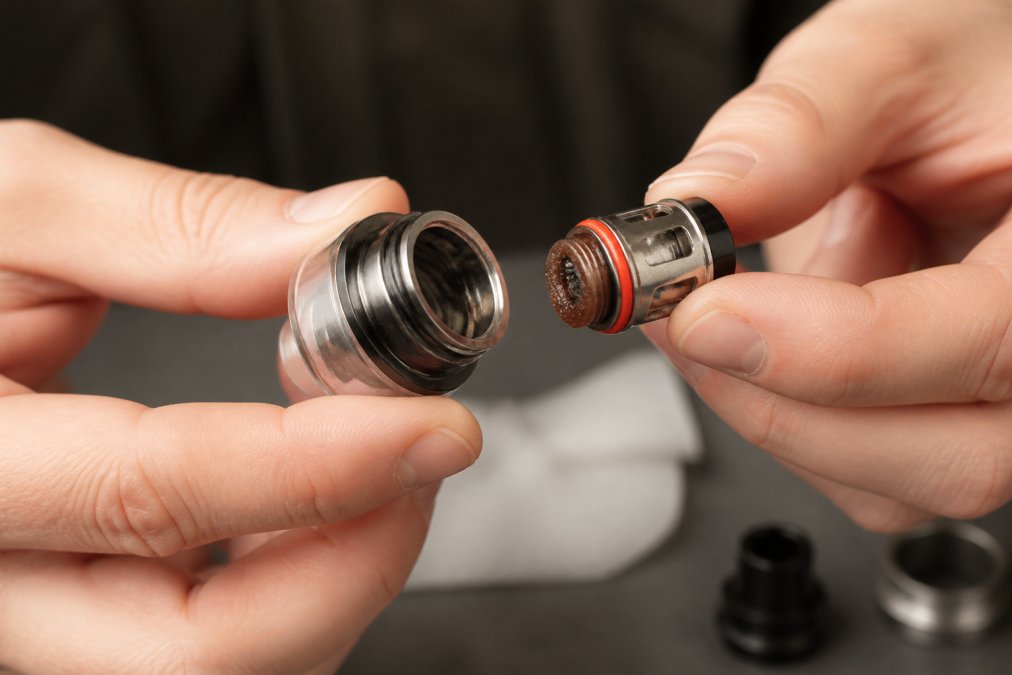
A flooded coil is the most common cause of spitback. Your coil is flooded when the wick holds more e-liquid than it can vaporize, typically from oversaturation, improper priming, or too much airflow.
Identifying a flooded coil
A flooded coil produces gurgling sounds, frequent spitback, burnt or wet taste, and liquid leaking from airflow holes. Remove the coil and check the wick: if it's visibly soaked or dripping, it's flooded. A healthy wick should look damp like a sponge, not wrung-out.
Step-by-step clearing process
To clear a flooded coil: remove it from your tank, hold it wick-down over a paper towel, gently tap to shake out excess liquid, dab with a dry towel (don't squeeze), air dry 2-3 minutes, reinstall, take 3-4 draws without firing to re-saturate evenly, then vape normally.
Adjusting Wattage and Airflow to Stop Spitback
Wattage and airflow work together to control coil firing and vapor travel. Mismatched settings are a leading cause of spitback. Temperature control (TC) modes on newer devices can prevent spitback before it starts.
Finding your device's optimal wattage
Every coil has a recommended wattage range where it vaporizes efficiently. Below the range, liquid pools; above it, the wick burns. Start at the low end and increase by 5 watts every 2-3 days until you find your sweet spot. Stop at the top of the range; going higher causes burnt taste and spitback.
Airflow adjustment techniques
Tighter airflow slows liquid movement and gives the coil more time to vaporize completely. If experiencing spitback, close your airflow ring halfway and test. The sweet spot is usually 60-75% open for sub-ohm devices and 30-50% open for pod systems. However, airflow that's too tight can also cause spitback in sub-ohm tanks by creating back-pressure.
Temperature control mode: a spitback prevention tool
Temperature control (TC) mode, available on most modern box mods, is one of the most effective ways to prevent spitback. TC monitors coil resistance and adjusts power to maintain a set temperature (typically 200-230°C), preventing the coil from superheating e-liquid. Install a TC-rated coil, set your device to TC mode, start at 200°C, and increase by 5°C increments until you reach your preferred flavor. Most users find 210-220°C optimal.
The wattage-airflow-liquid balance
Wattage, airflow, and liquid must align. Start with your coil's recommended wattage at the midpoint, set airflow to 60% open (sub-ohm) or 40% open (pods), and assess. If you get spitback, close airflow by 10% or lower wattage by 5 watts. If vapor is weak, open airflow by 10% or raise wattage by 5 watts.
E-Liquid Viscosity and PG/VG Ratio Impact
The PG/VG ratio in your e-liquid directly affects coil performance and spitback risk. Sweeteners, flavorings, and nicotine type also influence wick saturation and spitback.
Understanding PG/VG and coil saturation
High-PG liquids are thinner and absorb into wicks faster; high-VG liquids are thicker and move slowly. Match your liquid to your device: pod systems need 50/50 or 60/40 PG/VG; sub-ohm tanks need 70/30 or 80/20 VG/PG; high-wattage devices (80+ watts) need 90/10 VG/PG or higher.
E-liquid ingredient sensitivity: sweeteners and flavorings
Sweetened e-liquids are hygroscopic and increase wick saturation, causing flooding. High-flavor-concentration liquids (dessert, bakery, candy) are denser and slower to vaporize, also gunking up coils faster. Freebase nicotine vaporizes more readily than nicotine salts; if you've switched to salt nicotine and notice spitback, the salt may be saturating your wick faster than your coil can vaporize it.
Aspire Breeze Atomizer | 5pk →
Diagnostic framework: matching liquid to device
Use this checklist to ensure your e-liquid matches your device:
- Check the bottle label for PG/VG ratio. If it's not listed, contact the manufacturer.
- Assess sweetness: Is the liquid noticeably sweet? If yes, it's likely high in sweeteners. Consider a less-sweet alternative if spitback is frequent.
- Evaluate flavor intensity: Complex dessert or bakery flavors are denser than fruit or menthol. If you're experiencing spitback with a complex flavor, try a simpler profile.
- Confirm nicotine type: Are you using freebase or nicotine salts? Nicotine salts belong in low-wattage devices (pods, mouth-to-lung tanks). Freebase works in any device.
- Cross-reference with device specs: Your device manual or coil box will specify the ideal PG/VG range. Stay within it.
Real-world example: pod systems and high-PG liquid
Pod systems like the Caliburn or Whirl are engineered for 50/50 or 60/40 PG/VG liquids. If you fill a pod with an 80/20 VG/PG sub-ohm liquid, the thicker liquid wicks slowly, and the coil fires before the wick is fully saturated. This causes dry hits and, paradoxically, spitback as the coil superheats pockets of liquid.
Vape Maintenance Tips 2026: Prevent Spitback Before It Starts
The best fix is prevention, and implementing vape spitback solutions early keeps your device running smoothly and spitback-free. Regular maintenance keeps your device running smoothly and spitback-free.
Proper coil priming technique
Priming a coil correctly prevents flooding from day one. When you install a new coil, saturate the wick before you fire. Take 3-4 slow draws without pressing the fire button. This draws e-liquid into the wick evenly. Then fire at low wattage for 2-3 seconds and release.
Regular wick and atomizer care
Clean your atomizer chamber every 2-3 weeks. Empty the tank, remove the coil, and rinse the chamber with warm water. Dry it completely with paper towels. This removes old e-liquid residue and prevents buildup that can cause flooding.
Troubleshooting Vape Popping Sounds and Spitback
Popping sounds often accompany spitback, and they indicate the same underlying problem: too much liquid in your chamber or coil.
What popping indicates about your device
Popping happens when a pocket of e-liquid sits on your coil and superheats suddenly. The liquid vaporizes so fast it creates a small explosion, that's the popping sound. This also sends spitback up the chimney. If you hear popping, your coil is flooded or your airflow is too tight.
Device-specific fixes for pods vs. sub-ohm tanks
Pod systems and sub-ohm tanks have different architectures, so they need different troubleshooting approaches.
Pod systems (like Caliburn or Whirl devices) are compact and prone to flooding because the chamber is small. If your pod is popping or spitting, try these steps:
- Close the airflow ring to the tightest setting
- Replace the coil, pods flood more easily than tanks
- Use a higher-PG liquid (50/50 or 60/40 ratio)
- Avoid chain vaping; wait 10 seconds between draws
Sub-ohm tanks have larger chambers and more airflow control. If yours is popping:
- Open the airflow ring wider to increase vapor speed
- Lower your wattage by 10 watts and test
- Use a higher-VG liquid (70/30 or 80/20 ratio)
- Check that your coil is properly seated in the base
When to Replace Your Coil or Atomizer
Coils don't last forever. Even with perfect maintenance, they eventually wear out. Knowing when to replace yours prevents frustration and spitback.
- Spitback that doesn't improve with troubleshooting
- Burnt taste that won't go away
- Gurgling that persists after clearing the coil
- Visible dark or crusty buildup on the wick
- Reduced vapor production despite proper wattage
Frequently Asked Questions
Why does my vape keep spitting back hot liquid?
Vape spitback happens when excess e-liquid floods the coil and heating chamber. As the coil heats the liquid, it vaporizes too quickly, forcing droplets back through the mouthpiece. Common causes include oversaturated wicks, low wattage settings that don't vaporize liquid efficiently, and restricted airflow. Flooded coils are the most frequent culprit, they trap liquid instead of vaporizing it cleanly, creating the popping and spitting sensation.
How do I stop my vape from spitting hot liquid?
Start by checking your coil, if it's flooded, remove it and tap out excess liquid or let it dry briefly. Next, adjust your wattage to match your coil's resistance rating; too-low wattage prevents proper vaporization. Open your airflow control ring slightly to increase draw and help vaporize liquid more efficiently. If you're using a high-PG e-liquid, consider switching to a higher-VG ratio, which is thicker and less prone to flooding. Finally, prime new coils by letting them soak in the tank for 5-10 minutes before vaping.
Can a flooded coil cause vape spitting and popping?
Yes. A flooded coil is one of the primary causes of vape spitback and popping sounds. When the wick becomes oversaturated, excess e-liquid pools in the heating chamber. When you fire the device, the coil heats this liquid unevenly, creating rapid vaporization that forces droplets back up through the chimney and drip tip. You'll hear distinctive popping or crackling sounds alongside the spitting sensation. Replacing the coil or clearing the flooded chamber usually solves the problem immediately.
How often should I change my vape coil to prevent spitting?
Most coils last 1-4 weeks depending on usage frequency and e-liquid type. High-sweetener juices and heavy vaping can reduce coil life significantly. Replace your coil if you notice persistent spitback, reduced vapor production, muted flavor, or visible discoloration. Don't wait until spitback becomes severe, a fresh coil prevents the issue entirely. Quality replacement coils like those from Aspire and UWELL are available at Bay Roberts Vape and Glass Shop starting at $12.30, making regular replacement affordable and effective.